Technical debt is often discussed as an engineering concern. But when it slows improvements, creates inconsistent behavior, or makes the product harder to change safely, users begin paying the cost too.
Technical debt usually stays hidden inside the codebase.
At first, it may look like an internal engineering issue: duplicated components, hard-coded values, outdated dependencies, missing tests, difficult-to-maintain CSS, or workarounds added to meet a deadline. None of these necessarily changes what the user sees today.
The problem appears later, when the product needs to change.
A small interface improvement becomes difficult because the same pattern exists in five different places. An accessibility fix is applied to one component but not the others. A responsive issue returns because the layout depends on assumptions nobody wants to touch. A new interaction is avoided because the existing implementation is too difficult to extend safely.
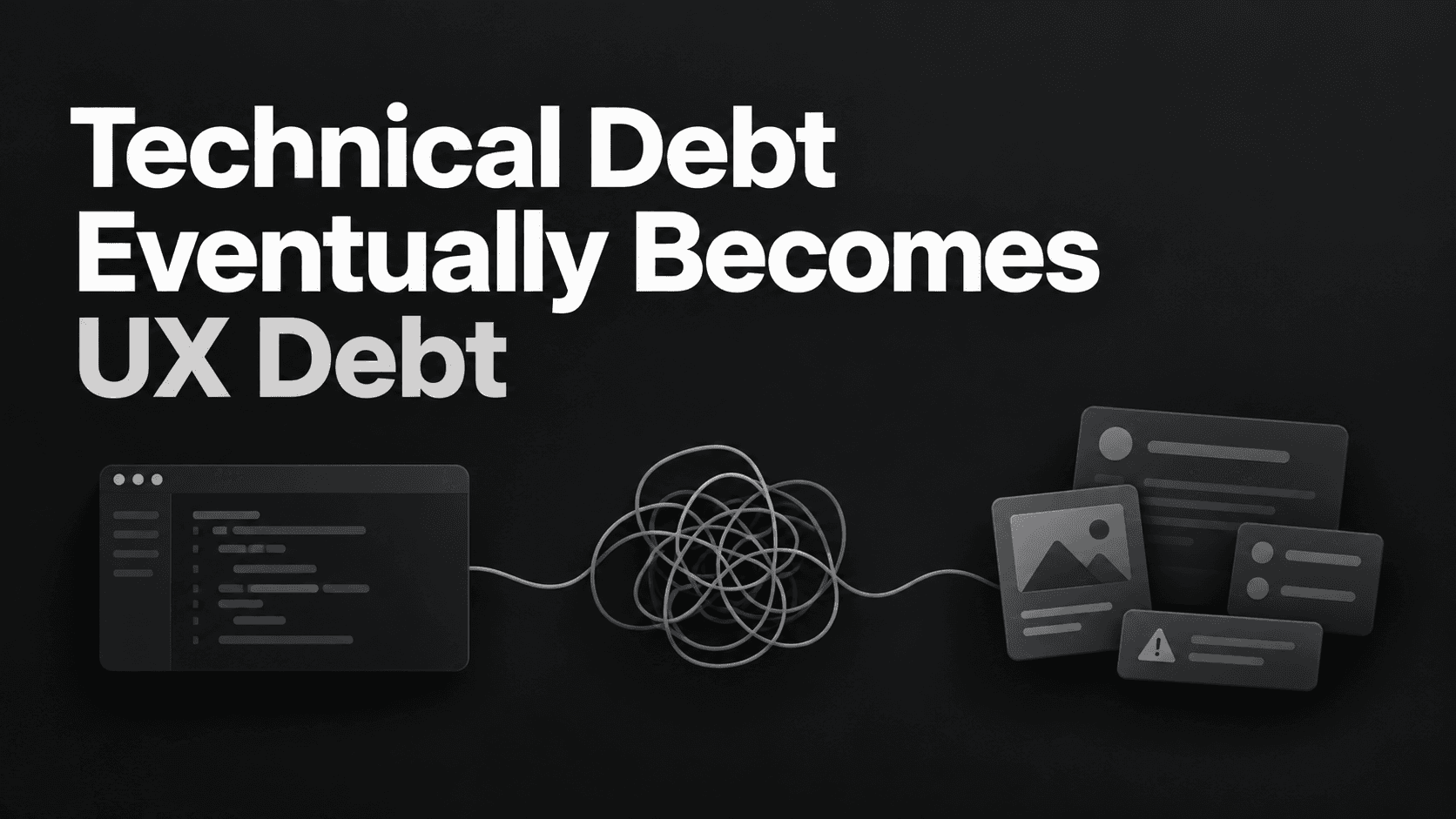
At that point, technical debt is no longer only technical. It has started shaping the user experience. UX debt is the accumulation of experience problems and limitations that make a product less consistent, usable, accessible, or adaptable over time.
Technical debt becomes UX debt when the cost of changing the system starts changing what users can experience.
The User Eventually Pays the Interest
Technical debt is often described using the language of borrowing: a team moves faster now and accepts a cost that will have to be paid later. That decision can be reasonable. Not every shortcut is irresponsible, and not every piece of debt needs to be removed immediately.
But debt has interest.
As it accumulates, teams spend more time working around the system instead of improving the product. Changes become slower. Regressions become more likely. Similar features behave differently because they were built at different times with different assumptions.
Users do not see the duplicated logic, outdated architecture, or missing test coverage. They see the effects:
- a form that behaves differently from another form in the same product,
- a mobile layout that breaks in one flow but not another,
- a loading experience that feels slower than it should,
- a keyboard interaction that works in one component and fails in another,
- or an improvement that remains on the roadmap because changing the underlying implementation is considered too risky.
The user experiences the interest even if they never know where it came from.
Small Engineering Shortcuts Can Change the Interface
The connection between technical debt and UX is easiest to see in interface code.
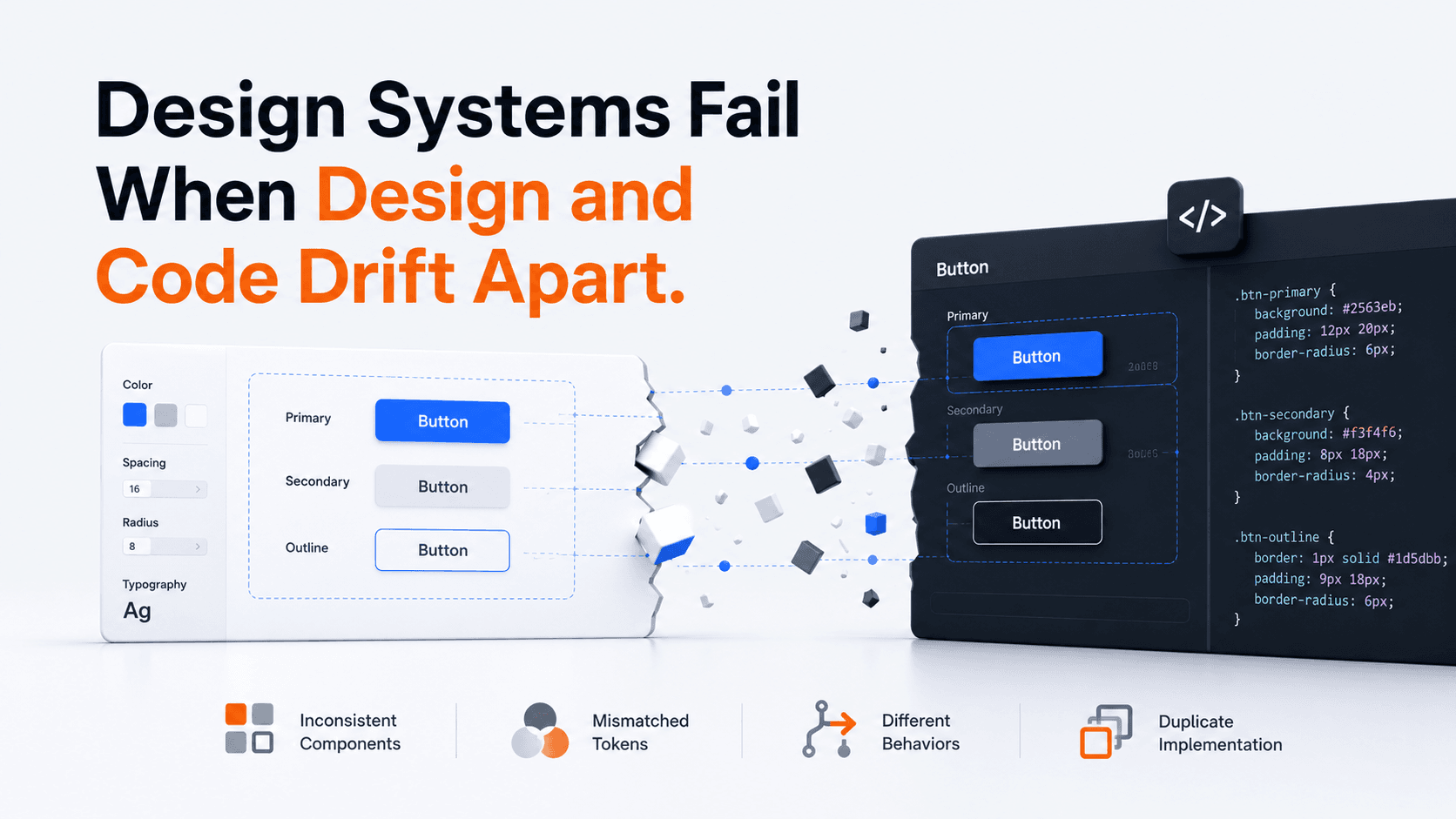
Imagine a product has one shared button component. Over time, several teams need small exceptions, so they create local versions instead of extending the shared component. The differences are minor at first: a slightly different loading state, a different disabled style, another icon position.
Months later, changing the button is no longer one change. It is several.
A new focus treatment may reach only the shared version. A label change may fit correctly in one implementation but overflow in another. One button may prevent duplicate submissions while another does not.
The original technical shortcut has become a visible inconsistency.
The same pattern appears with spacing, forms, modals, tables, validation, responsive behavior, and data states. When implementation fragments, experience usually fragments with it.
How Technical Debt Reaches the User
| Technical debt | Product consequence | UX consequence |
| Duplicated UI components | Changes must be repeated and may diverge | Similar interactions behave differently |
| Hard-to-maintain layout code | Teams avoid touching responsive behavior | Breakpoints and content fail in edge cases |
| Missing tests | Shared components become risky to change | Bugs return after otherwise useful improvements |
| Hard-coded design values | Visual updates require scattered edits | Spacing, color, and states become inconsistent |
| Workaround-heavy flows | New features inherit old constraints | Users face extra steps, delays, or confusing behavior |
Debt Makes Good UX Harder to Ship
One of the less visible effects of technical debt is that it changes which UX improvements are considered practical.
A designer may propose a clearer interaction, but implementing it requires changing an old component used across the product. A team may identify an accessibility problem, but the behavior is duplicated in several places and cannot be fixed confidently without broader regression testing. A simple content change may need special handling because the layout was built around fixed text lengths.
Consider a form pattern that has been copied across several parts of a product instead of being built from a shared accessible component. When the team discovers that error messages are not properly announced to screen readers, fixing one form is easy. Fixing every variation safely is not. What began as implementation duplication now determines whether some users can complete the task at all.
This is where technical debt begins limiting design decisions before users ever see them.
UX debt is not always something users can point to. Sometimes it shows up as an improvement that never ships because the system makes it too expensive or risky to build.
The team starts asking not only “What is the right experience?” but also “What can we safely change?”
That question is sometimes necessary. Every product has constraints. But if the same answer keeps appearing because the implementation cannot support reasonable product changes, the constraint itself has become part of the UX problem.
When “Temporary” Becomes the Product
Most technical debt does not enter a codebase because someone intentionally chose poor quality.
A release date moves forward. An API is not ready. A feature needs quick validation. A team adds a temporary condition, duplicates a component, or builds around a limitation, intending to improve it later.
The risk is not the temporary solution itself. The risk is forgetting that it was temporary.
Once users depend on the feature, other parts of the product begin depending on the same implementation. The workaround becomes harder to remove, and future decisions are made around it. Eventually, the temporary constraint starts defining the experience.
This is why technical debt needs visibility. A known shortcut can be managed. An invisible shortcut quietly becomes architecture.
Not All Technical Debt Is Bad
Technical debt is not automatically a sign of poor engineering.
Teams sometimes accept debt intentionally because learning quickly is more valuable than building the final architecture too early. A prototype may use a simplified implementation. A new feature may launch with a narrow scope. A component may be duplicated temporarily while the team learns whether the pattern should become reusable.
The important distinction is whether the debt is understood.
Useful questions are not “Do we have technical debt?” but:
- Do we know where it is?
- Do we understand what product behavior it affects?
- Is it making future changes slower or riskier?
- Is it creating inconsistencies users can already experience?
- And is the cost of carrying it now higher than the cost of addressing it?
That turns technical debt from an unclear engineering concern into a product decision.
UX Engineering Makes the Connection Visible
Technical debt and UX debt often live in different conversations.
Engineering sees maintainability, duplication, test coverage, architecture, and implementation risk. Design sees inconsistency, interaction problems, inaccessible behavior, and limitations on future improvements.
UX Engineering sits close enough to both sides to connect them.
A UX Engineer can see that three visually similar components are backed by different implementations. They can recognize that an accessibility issue is not isolated to one screen but belongs in the shared component. They can explain why a frontend constraint is creating recurring product problems rather than treating each problem as a separate design fix.
That connection matters because the right solution is not always “refactor the code” and it is not always “redesign the interface.” Sometimes the best decision is to improve the underlying component. Sometimes it is to simplify the design. Sometimes it is to accept the debt because its user impact is low and the team has more important work.
The value is in making the decision explicit.
Pay Down Debt Where Users Feel It Most
Large codebases will always contain debt. Trying to eliminate all of it is usually neither realistic nor useful.
A better approach is to understand where technical debt is producing product problems.
Debt deserves more attention when it repeatedly causes regressions, blocks accessibility improvements, slows high-value product changes, creates inconsistent interactions, harms performance, or forces teams to keep designing around the same limitation.
Two components can carry similar technical debt and still deserve different priorities. Duplication on a rarely used internal settings screen may have little user impact. The same duplication in checkout, authentication, or core navigation can create repeated accessibility issues, regressions, and inconsistent behavior. The amount of debt may be similar. Its product impact is not.
This gives managers and product teams a stronger reason to prioritize the work. The conversation is no longer about cleaning up code just to clean it up. It is about protecting the quality and adaptability of the product.
Technical Quality Becomes Product Quality
Users do not experience the architecture directly. They experience what the architecture makes possible.
Clean code does not guarantee good UX, and reducing technical debt does not automatically improve a product. The connection matters when implementation decisions begin affecting consistency, accessibility, performance, or the team’s ability to respond to user needs. At that point, engineering quality and experience quality are no longer separate concerns.
The debt may have started in the codebase. Eventually, the user starts paying for it.